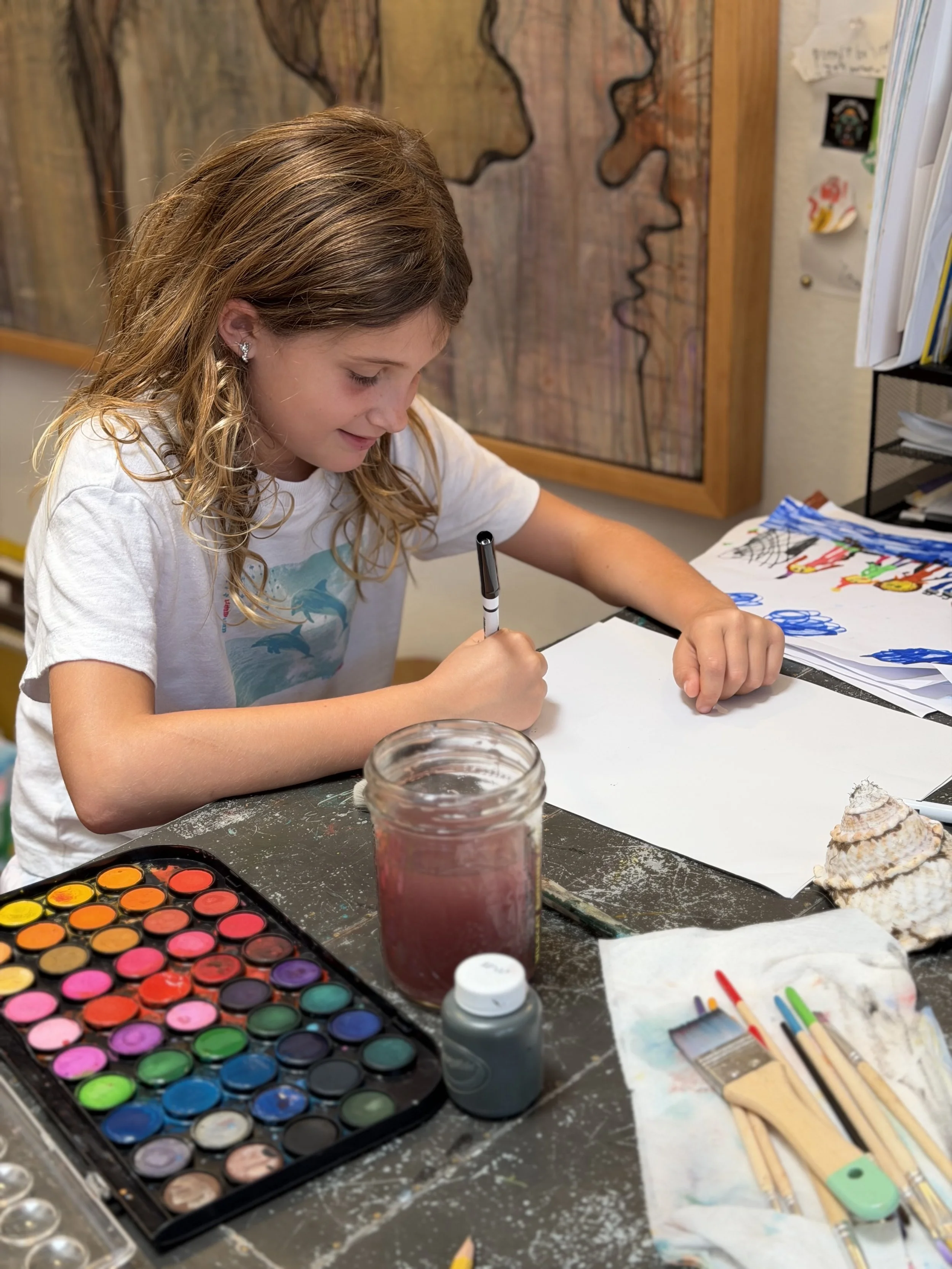
The Program

A different way to experience art.

Form & Wonder is a creative learning program for children that uses visual art to develop skills that reach far beyond drawing or making.

Rather than beginning with a finished example and asking children to reproduce it, we begin with observation, curiosity, and a question.

Children are encouraged to look closely, notice what others might overlook, explore possibilities, experiment with materials, make independent choices, and develop their own creative solutions.

There is no single picture everyone is expected to make.

The process is the program.

Look. Think. Create.

A simple framework for every experience.

LOOK

Before creating, we observe.

Children slow down and spend time really looking at an object, shape, texture, pattern, image, material, or idea. They learn to notice relationships and details that aren't always apparent at first glance.

THINK

Observation leads to questions.

What do I notice? What surprises me? What might happen if I change this? Is there another way to approach the problem?

Children are encouraged to make connections, develop ideas, and decide what they think rather than waiting to be told what to do next.

CREATE

Ideas become experiments.

Children draw, construct, manipulate materials, test possibilities, make mistakes, change direction, and refine their work.

The goal isn't for every child to arrive at the same result. It's for each child to have a reason behind the choices they've made.

What a Form & Wonder Session Feels Like

Less instruction. More discovery.

A Form & Wonder session isn't built around following along as an instructor demonstrates how to make a particular picture. Instead, I act more as a creative coach.

I introduce an observation, object, material, challenge, or question and provide enough structure to get children started. From there, I use questions, conversation, demonstrations, and individual guidance to help them push their own thinking further.

A session might move through:

Encounter → Observe → Question → Explore → Create → Reflect

Children may work quietly and independently at one moment, exchange ideas with the group at another, experiment with unfamiliar materials, abandon an approach that isn't working, or discover something completely unexpected.

That unpredictability isn't a problem to eliminate. It's part of the experience.

The Wonder Object

Everything begins with looking again.

One of the ideas at the heart of Form & Wonder is the Wonder Object an ordinary object that becomes extraordinary when we give it our full attention.

It might be a pepper, shell, seed pod, piece of fruit, mechanical object, unusual tool, or something found in nature.

At first, a child might simply see a pepper. But look longer.

There are curves, folds, shadows, asymmetry, reflections, colors, textures, patterns and unexpected shapes. Turn it around and it becomes something different again.

The Wonder Object teaches one of the central ideas of the program:

The more closely we look, the more there is to discover.

And that habit of looking again can extend far beyond art.

What Children Are Practicing

Skills for creativity and for life.

Observation
Learning to slow down, focus attention, and notice more.

Curiosity
Asking questions and becoming interested in what isn't immediately obvious.

Independent Thinking
Making choices without constantly looking for the “correct” answer.

Creative Problem-Solving
Trying different approaches when the first solution doesn't work.

Experimentation & Resilience
Becoming more comfortable with mistakes, uncertainty, revision, and starting again.

Creative Confidence
Learning to trust personal ideas, preferences, and judgment.

Then I'd add one important sentence:

Artistic skills develop along the way but producing technically perfect artwork is not the measure of success.

That's an important distinction for Form & Wonder.

Every Child's Work Should Look Different

If everyone's work looks the same, we've missed the point.

Children naturally compare themselves to one another. Art classes can sometimes reinforce that by presenting a finished example and measuring success by how closely a child reproduces it.

Form & Wonder takes a different approach.

Children may begin with the same object, question, material, or challenge but they aren't expected to end in the same place.

One child may become fascinated by shape. Another by texture. Another might invent a story, discover a pattern, change the rules entirely, or take the project somewhere I hadn't anticipated.

Those differences are valuable.

I want children to leave Form & Wonder feeling proud not because their work looks like mine, but because they can say:

“I made this choice. I had this idea. I figured this out.”